Core Concepts (V2)
This page defines the V2 model and translates it from V1 terminology.
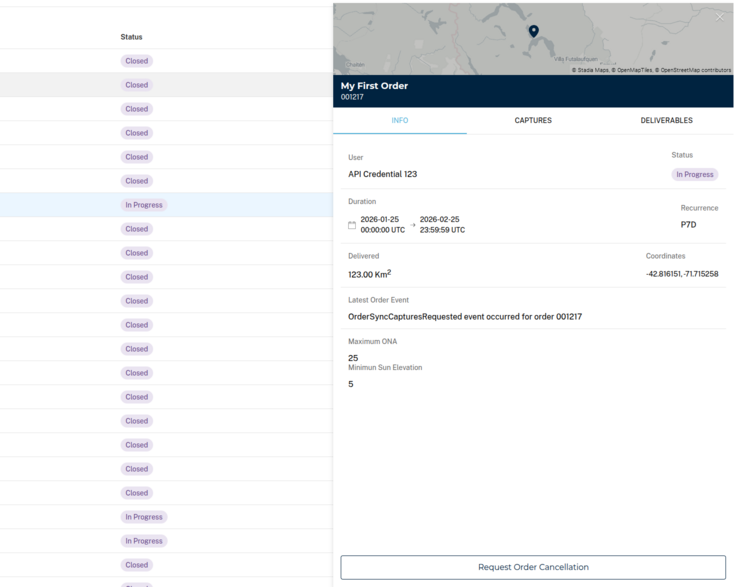
The V2 lifecycle: Order → Capture → Deliverable
V2 is built around four core entities that represent your complete workflow:
- Order: Your purchase request for a product (archive, tasking, etc.)
- Capture: The source satellite imagery that fulfills your order
- Deliverable: The final product generated from the capture and delivered to you
- Events: Detailed record of what happened at each stage (why it succeeded, why it failed, etc.)
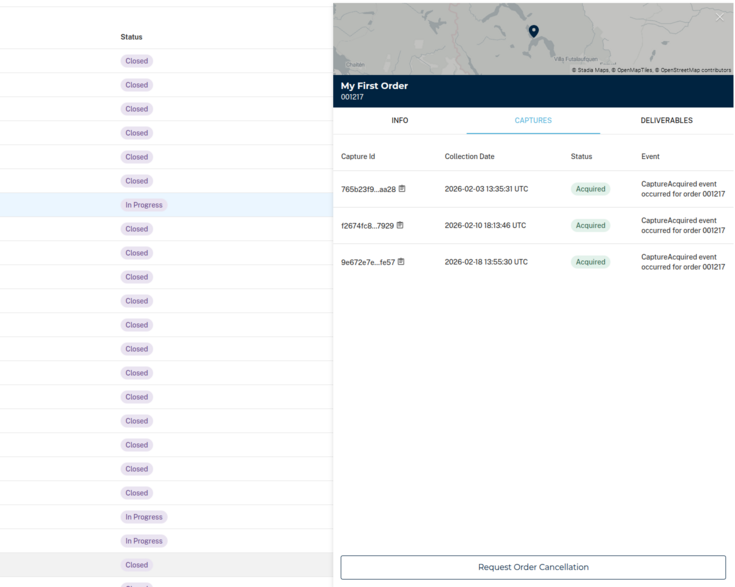
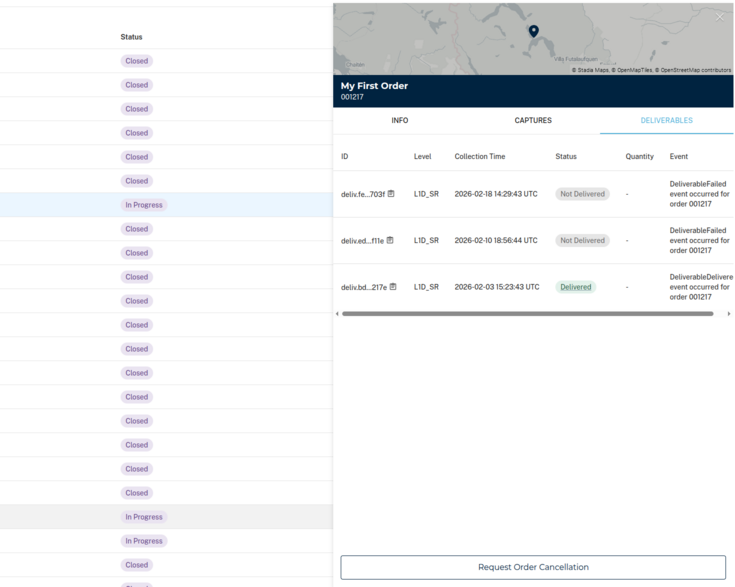
This hierarchy flows from order creation → capture collection or retrieval → deliverable generation, with events tracking every transition.
Context: Organization, Contract, Project
At a higher level, all orders live within a hierarchy for permissions and organization:
- Organization: The company you belong to (can have many users and contracts)
- Contract: The permissions boundary for users. It defines what users can and cannot do and which products are assigned. All users inside a contract see the same data.
- Project: An optional grouping to organize your orders within a contract (like a folder). In V2, projects now work for both tasking and archive orders.
You won't interact with these concepts in basic workflows, but they determine what products you can order and how your usage is tracked.
V1 to V2 mapping
| V1 term | V2 term | Notes |
|---|---|---|
| Task | Order | Orders replace tasks as the top-level request. |
| Capture | Capture | Same concept, but tied to orders and deliverables. |
| Delivery / Outcome | Deliverable | Deliverables are the final assets you receive. |
| Contract | Contract | Same concept; unchanged. |
| Project | Project | Existing concept, now extended to organize archive orders as well. |
Want to dive deeper? See the full Migration Decision Matrix and V1 → V2 feature comparison.